
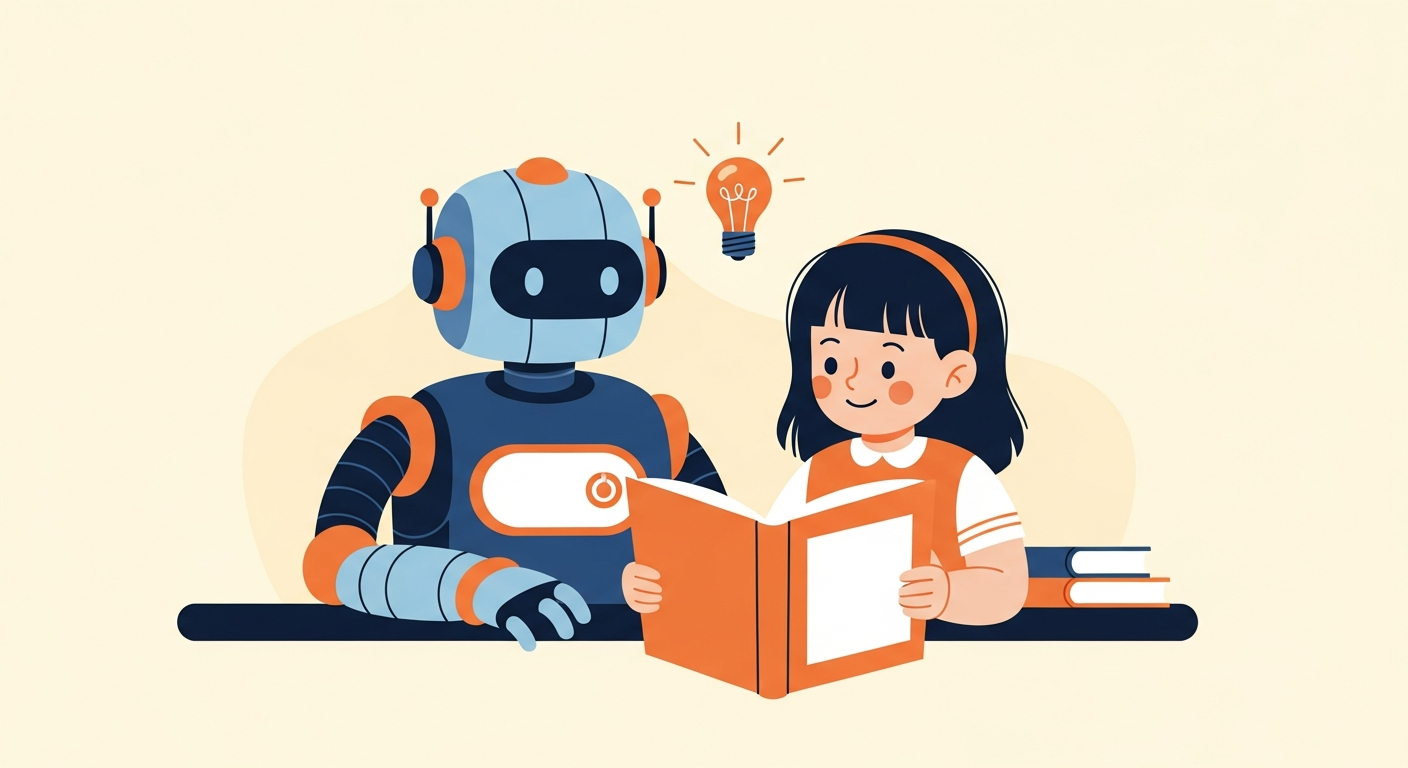
AI can support children’s learning in powerful ways. It can explain concepts, generate practice questions, give feedback, and help students revise more independently. But like any tool, AI must be used correctly.
A calculator can help a student check answers, but it cannot replace understanding. In the same way, AI can support learning, but it should not replace thinking.
AI can explain concepts in different ways
Every child learns differently. Some understand better through examples. Some need diagrams. Some need step-by-step explanations. Some need simpler language first before moving to exam-style answers.
AI can help by explaining the same concept in different ways. For example, a child can ask:
“Explain photosynthesis to a Primary 5 student.”
“Give me a real-life example of heat transfer.”
“Explain this algebra question step by step.”
“Make this Science explanation easier to understand.”
This can be very helpful when a child is stuck at home.
AI can create practice questions
Practice is important for improvement. AI can help generate:
- Basic questions
- Exam-style questions
- Multiple-choice questions
- Open-ended questions
- Vocabulary questions
- Grammar practice
- Revision quizzes
This helps students get more practice beyond school worksheets. However, students should still check the quality of the questions, especially for exam syllabus accuracy.
AI can support revision
Many students do not know how to revise properly. AI can help students create:
- Study schedules
- Topic summaries
- Flashcards
- Self-quizzes
- Mistake checklists
- Revision plans before exams
This can help children become more organised.
AI can improve writing
For English and composition, AI can help students improve their writing if used properly. Students can ask AI to:
- Suggest stronger vocabulary
- Improve sentence variety
- Check grammar
- Give feedback on clarity
- Suggest better paragraph structure
- Explain why a sentence sounds awkward
But students should not let AI write the whole composition for them. If AI writes everything, the child may submit better work but become a weaker writer. The correct approach is:
Let AI give feedback. Let the child do the thinking and rewriting.
AI can build independent learning
One of the biggest benefits of AI is that children can ask questions anytime. A child who is shy in class may ask AI:
“Why is my answer wrong?”
“Can you explain this more simply?”
“Can you give me another example?”
This can encourage curiosity. But children still need teachers, tutors, and parents. AI cannot fully understand a child’s emotions, confidence level, learning history, or personal struggles the way a human educator can.
The danger of using AI wrongly
AI becomes harmful when students use it to avoid effort. Examples of poor AI use include:
- Copying answers directly
- Asking AI to complete homework
- Submitting AI-written essays as their own
- Believing every answer without checking
- Using AI instead of learning the basics
- Avoiding difficult thinking
This creates dependence. The child may appear productive, but the brain is not becoming stronger.
The best way to use AI for learning
A good AI learning routine looks like this:
- Try the question first.
- Ask AI for hints, not full answers.
- Compare AI’s explanation with your own method.
- Check with trusted sources.
- Redo the question without AI.
- Explain the final answer in your own words.
This keeps the child involved in the learning process.
Parent takeaway
AI can help children learn better, but only when it is used as a learning partner, not a shortcut. At ADA Tuition, we believe AI should strengthen a child’s understanding, confidence, and curiosity — not replace effort, thinking, or good teaching. Our partner Infositter runs hands-on AI workshops that teach children exactly how to use AI the right way.
← Back to The Journal