
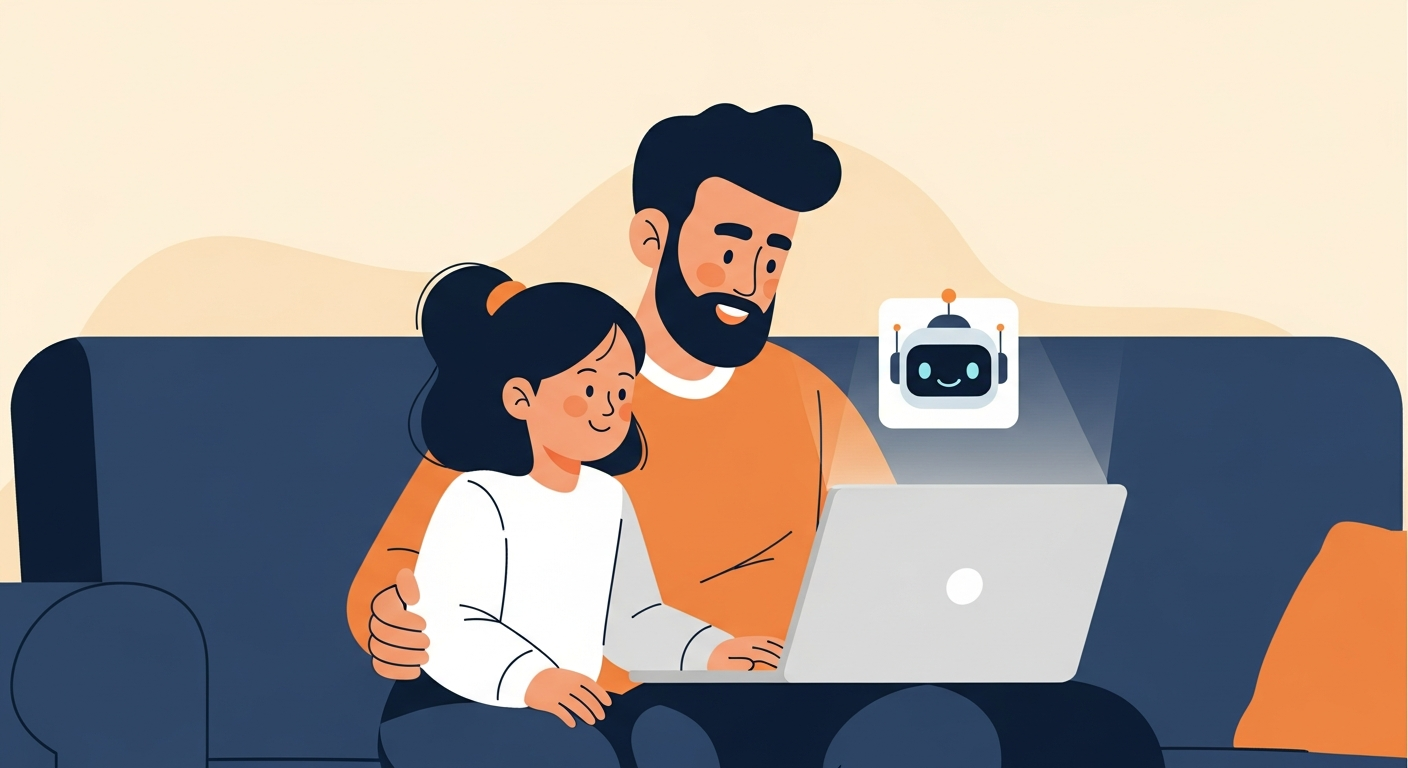
Parents do not need to be AI experts to help their children begin learning about AI. The most important thing is to guide children with curiosity, safety, and responsibility.
AI should not be introduced as a shortcut for homework. It should be introduced as a tool for learning, questioning, and improving.
Start with simple conversations
A good first step is to ask children where they already see AI. For example:
“How does YouTube know what video to recommend?”
“How does Google Maps suggest the fastest route?”
“How does a phone recognise a face in a photo?”
“How does a translation app know what words to use?”
These questions help children realise that AI is already around them.
Teach children that AI can be wrong
Children must understand that AI answers are not always correct. Parents can say:
“AI is useful, but it is not perfect. We must check its answers.”
This is one of the most important habits in AI learning. Children should learn to compare AI responses with:
- School notes
- Textbooks
- Teachers’ explanations
- Reliable websites
- Their own reasoning
This builds critical thinking.
Use AI for explanation, not copying
Parents can allow children to use AI in healthy ways.
Good use:
“Explain this Science concept in simpler words.”
“Give me a hint for this Math question.”
“Ask me five revision questions.”
“Check my grammar and explain the corrections.”
Poor use:
“Do my homework for me.”
“Write my whole composition.”
“Give me the answer so I can copy.”
The difference is whether the child is still thinking.
Create family rules for AI use
Just as families may have rules for screen time, they should also have rules for AI use. For example:
- AI cannot be used to copy homework.
- AI answers must be checked.
- Personal information should not be entered into AI tools.
- AI can be used for explanation and practice.
- The child must be able to explain the final answer in their own words.
UNICEF’s guidance on AI and children emphasises the importance of child-centred AI policies and systems that protect children’s rights and support safe use.
Encourage children to ask better questions
AI works better when the child asks better questions. Instead of:
“Explain Math.”
A better prompt is:
“Explain how to solve Primary 6 ratio word problems using a simple example.”
Instead of:
“Help me with Science.”
A better prompt is:
“Explain the difference between evaporation and boiling for a Primary 5 student.”
This teaches children clarity of thought.
Let children create with AI
AI is not only for answers. It can also help children create. Children can use AI to:
- Create a quiz
- Plan a story
- Generate project ideas
- Design a simple study schedule
- Practise interview questions
- Build a presentation outline
- Create flashcards
This helps children see AI as a creative partner.
Parent takeaway
Parents do not need to know everything about AI before introducing it to children. Start with three simple rules:
Use AI to learn.
Check what AI says.
Think for yourself.
At ADA Tuition, we believe children should learn how to use AI wisely, safely, and confidently. For families who want structured AI workshops — hands-on, age-appropriate, and parent-friendly — our partner Infositter runs AI courses for children and adults right here in Singapore.
← Back to The Journal