
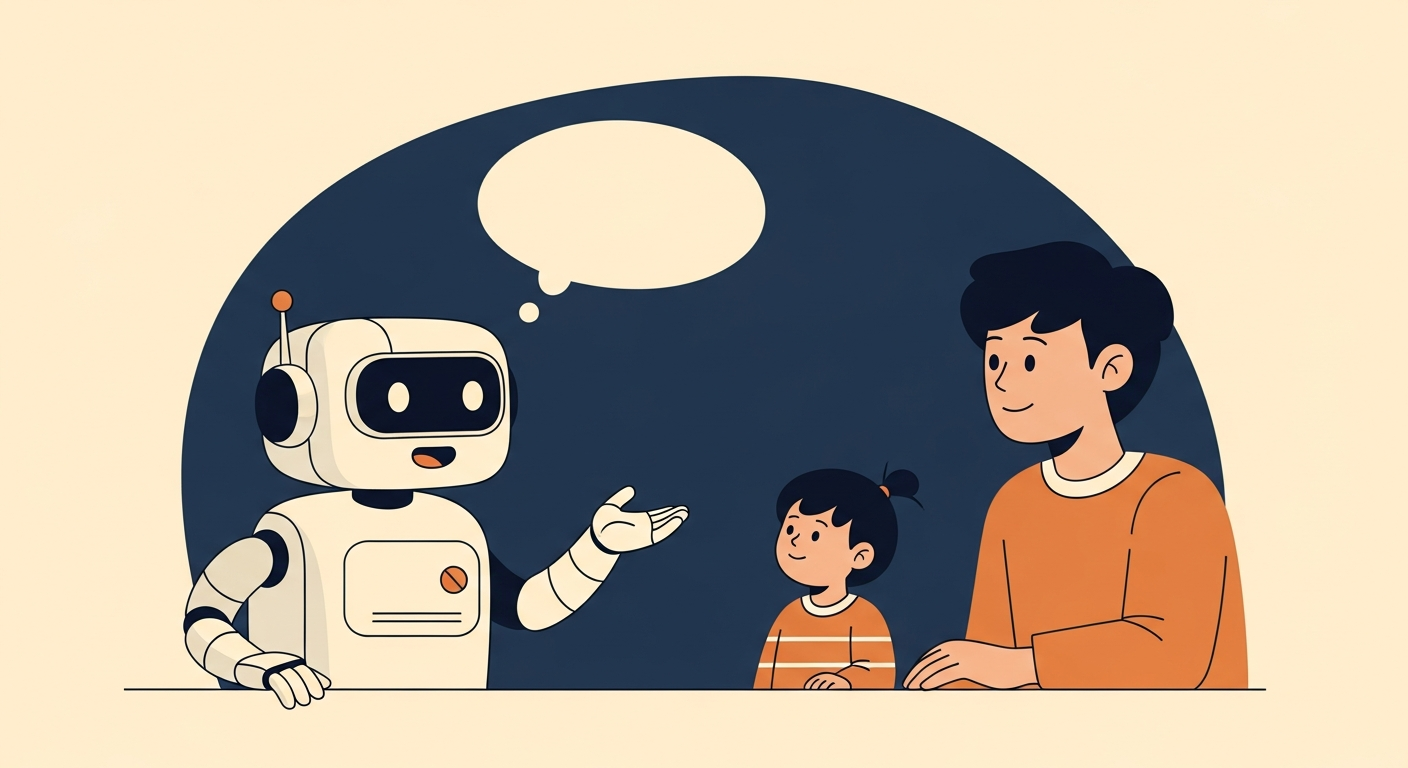
Many parents have heard the term “AI”, but may not be sure how to explain it to children. AI stands for Artificial Intelligence. In simple terms, AI refers to computer systems that can perform tasks that usually require human intelligence.
These tasks may include:
- Recognising patterns
- Understanding language
- Answering questions
- Making predictions
- Recommending content
- Generating images or text
- Solving problems
AI does not “think” exactly like a human. It works by using data, patterns, models, and rules to produce useful results.
A simple example
Imagine a child watches videos online. After watching several videos about football, the platform starts recommending more football videos. Why? Because the system has noticed a pattern:
“This user watches football videos. The user may like more football videos.”
That recommendation system is a form of AI.
AI learns from data
AI becomes useful because it learns from large amounts of data. For example, an AI translation tool may study many examples of sentences in different languages. Over time, it learns patterns in how words and meanings are connected.
But this also means AI can make mistakes. If the data is incomplete, biased, outdated, or misunderstood, the AI answer may be wrong. This is why children must learn an important rule:
AI can help us, but we must still think.
AI is not magic
Some children may think AI is like a super brain that knows everything. This is not true. AI can be powerful, but it has limitations. It may:
- Give wrong answers confidently
- Misunderstand the question
- Miss important context
- Produce biased answers
- Make up information
- Struggle with moral judgement
- Lack human empathy
UNESCO notes that AI in education has great potential, but also brings risks and challenges that require careful policy and ethical guidance. So children should learn to use AI as a tool, not as a replacement for their own brain.
How children can use AI for learning
Used correctly, AI can help children learn in many ways. A child can ask AI to:
- Explain a difficult concept in simpler words
- Give practice questions
- Check grammar
- Suggest ideas for writing
- Summarise a topic
- Create a revision plan
- Explain a Math method step by step
- Turn notes into quiz questions
However, the child should not simply copy and submit the answer. The best use of AI is:
Use AI to understand better, not to avoid learning.
A simple rule for children
Parents can teach children this rule:
Ask AI. Check AI. Think beyond AI.
This means:
- Ask AI for help or explanation.
- Check AI using textbooks, teachers, trusted websites, or common sense.
- Think beyond AI by adding your own understanding, examples, and reasoning.
This helps children stay active in their learning.
Parent takeaway
AI is not something children should fear. It is also not something they should use blindly. AI is a powerful learning tool, but children need guidance to use it wisely.
At ADA Tuition, we believe that the future belongs not just to children who can use technology, but to children who can think clearly, learn deeply, and make responsible decisions. Together with our partner Infositter, we’re helping families introduce AI to children the right way.
← Back to The Journal