
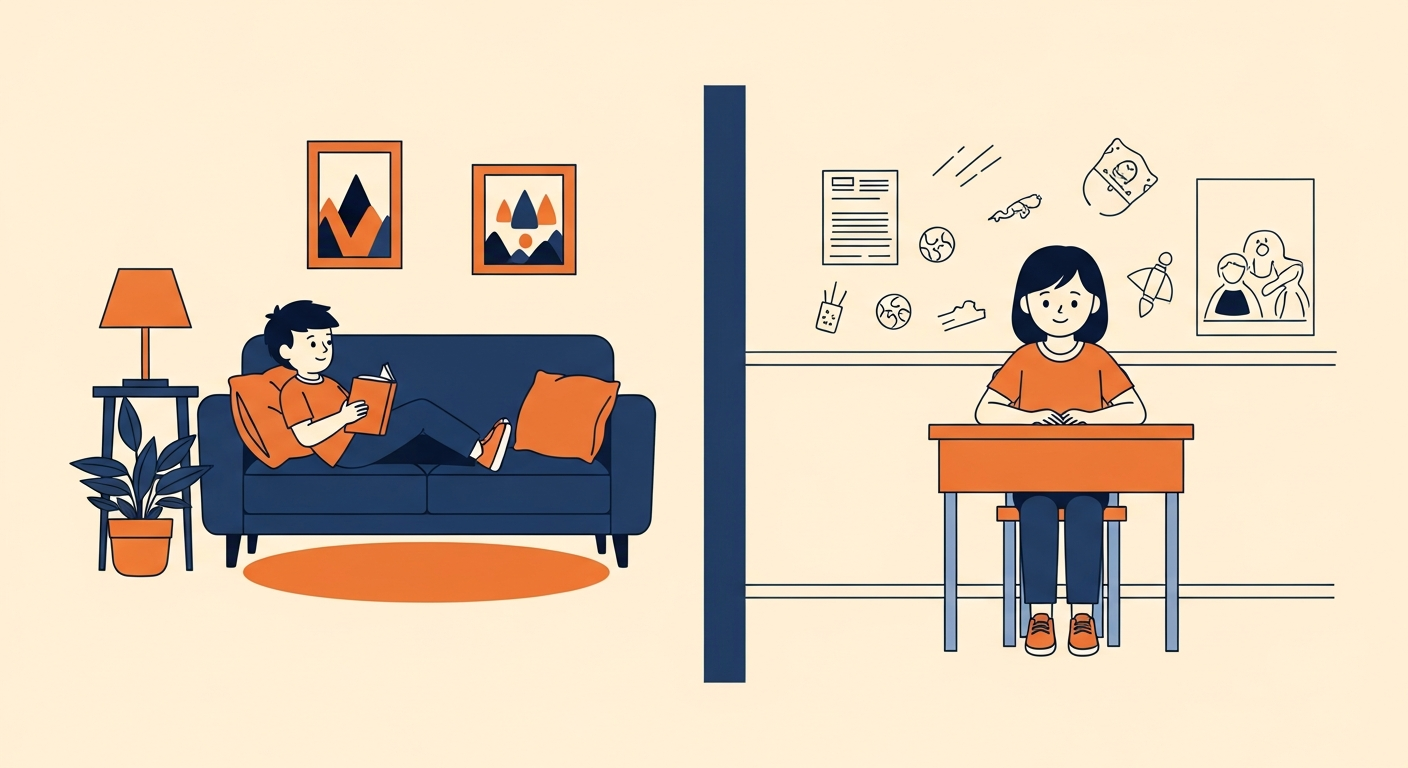
Many parents are surprised when teachers describe their child as “polite, focused and well-behaved.” At home, the same child argues, slams doors, and refuses homework. Parents wonder, “Are we talking about the same child?”
You are. And what you are seeing is not bad parenting or a difficult child. It is something more important: information about how your child is coping.
Children may hold in stress during school
School is a public space. Children quickly learn that they should “keep it together” in front of teachers and classmates. So they push down frustration, embarrassment, and tiredness, and they perform.
This takes energy. By the time they reach home, the effort of holding it all in for six or seven hours has used them up.
Home may be where emotions finally come out
Home is the one place a child feels safe enough to let down their guard. That is actually a good thing — even when it looks like the opposite. A child who explodes at home but is calm in school is usually saying:
“You are the people I trust enough to fall apart in front of.”
This does not mean parents should accept rudeness. But it does mean the explosion is rarely about you. It is about the weight they have been carrying all day.
Resistance may be caused by anxiety or skill gaps
The Child Mind Institute notes that anxiety in children can be hard to recognise because it often shows up as stomachaches, acting out, ADHD-like behaviour, or learning problems — rather than the child simply saying “I’m anxious.”
So when a child suddenly refuses to do Math homework, the real cause may not be laziness. It may be:
- They don’t understand the topic and feel embarrassed to admit it.
- They tried once and failed, and don’t want to feel that again.
- They feel rushed and can’t think clearly under that pressure.
- They’ve had a bad day socially and can’t add more strain.
Pushing harder rarely fixes any of these. Slowing down and asking better questions usually does.
How parents can observe patterns
Instead of reacting to each incident, keep a quiet mental log for a week or two:
- What time of day are the meltdowns happening?
- Is it linked to a specific subject?
- Is it worse on certain weekdays?
- What happened at school just before?
- How much sleep did they get the night before?
Patterns reveal causes. Causes reveal solutions.
How to respond in the moment
When your child melts down, the most useful thing is usually not a lecture. Try:
“I can see you’re really upset. Let’s pause. We can talk about this in 10 minutes.”
This gives both of you space to step out of the heat. Real conversations happen after the storm, not during it.
When to speak to teachers or tutors
If the gap between home behaviour and school behaviour is large and lasting, that is worth a conversation with the form teacher. They may see things you don’t — friendships, social pressures, classroom dynamics. A tutor who sees the child weekly in a small-group setting can also help bridge the picture, because the child often opens up in that middle space.
Parent takeaway
Behaviour is communication. A child who behaves differently at home and in school is not being two-faced. They are showing you where the trust is — and where the strain is.
At ADA, we look beyond behaviour. We try to understand what the child is actually struggling with before deciding how to help.
← Back to The Journal